







Cart
Your shopping cart is empty! Aluminum welding
Times Read: 411 Comments: 0
What is aluminum welding?
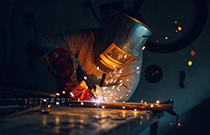
Aluminum welding is a process in which aluminum or its alloy parts are connected with the help of heat and pressure. Although the principle is similar to steel welding, aluminum behaves completely differently — it is soft, very sensitive to pollution and overheating, and has an oxide layer that melts at much higher temperatures than the metal itself.
Why is aluminum difficult to weld?
- High thermal conductivity - Aluminum dissipates heat very quickly, therefore:
- A larger amount of heat is required at the beginning of welding
- parts can be easily deformed
- thin sheets can burn out
- Oxide layer - Alumina melts around 3700°F (2037°C), while aluminum itself melts around 1200°F (650°C). This means that the oxide must be removed before welding, otherwise:
- the seam will be porous
- metal can burn out
- will not form proper fusion
- Porosity and contamination - Aluminum in the liquid state absorbs hydrogen, which creates pores in the seam. Very thorough cleaning is required — aluminum must be welded to the most critical position.
- No discoloration before melting – Unlike steel, aluminum does not change color before it begins to melt. The welder may not notice the moment when the metal begins to flow → burnouts.
The most popular methods of welding aluminum
- TIG (GTAW) welding - The most accurate and popular method for aluminum.
- Uses AC mode to "break" the oxide layer
- Provides a clean, high-quality seam
- Ideal for thin sheets and precision work
- MIG (GMAW) welding - Suitable for thicker materials.
- Faster than TIG
- Less accurate, but effective in production
- Argon/helium mixtures may be used for higher penetration capacity
- MMA Electrode Welding
- It's less common because the preparation of basic matreals requires additional skills
- Dating Methods
- Laser welding – high precision, little deformation
- Electron beam welding – high requirements, vacuum environment
- Resistance welding – for thin materials
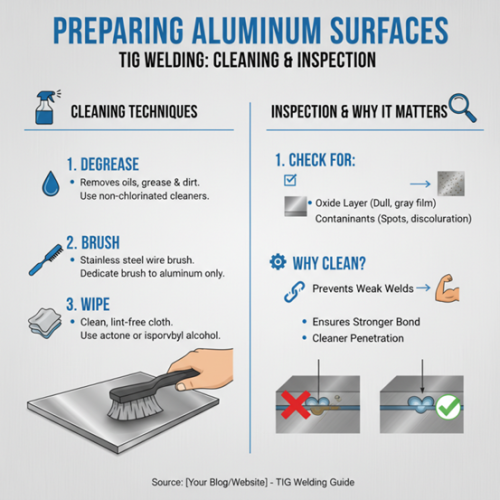
How to properly prepare aluminum for welding?
- Clean the oxide layer - Alumina melts at a much higher temperature than the metal itself, so it must be removed.
- A stainless steel brush designed exclusively for aluminum is used
- Light grinding or dry cleaning can also be used
- Clean immediately before welding so that oxide does not form again
- Degrease the surface - Oils and fats cause porosity and seam defects.
- Acetone or other suitable solvent shall be used
- Wipe with a clean, fiber-free cloth
- Never touch the surface with your bare hands
- Choose the right method and equipment - TIG and MIG are the most common methods for aluminum.
- TIG: uses AC mode and argon
- MIG: Argon/helium mixtures are used for thicker materials
- Check that the equipment provides sufficient power
- Choose the right filler material - the filler material must match the aluminum alloy.
- Popular variants: 4043, 5356
- Check compatibility with the base metal
- Avoid the risks of galvanic corrosion
- Controls heat - Aluminum heats up quickly and can burn out.
- Start with more power, reduce during the process
- Short seams and pauses are used
- Consider preheating the part (50-120°C)
The most common problems and how to fix them
- Porosity -
Causes: dirty surface, humidity, incorrect gas flow rate
Solutions: thorough cleaning, dry equipment, proper gas protection
- Burnouts –
Causes: too much heat, thin material
Solutions: shorter seams, lower amperage start, TIG with AC mode
- Deformations-
Causes: high thermal conductivity of aluminum
Solutions: preheating of the part, symmetrical welding, stiffeners
What shielding gas to use?
Method | Gas | Application |
TIG | 100% argon | thin sheets, precise works |
MIG | Argons + 25–75% hēlijs | thicker materials, deeper penetration |
What filling material to choose?
4043 – universal, flows well, little risk of cracks
5356 – more durable, suitable for constructions
Summary
Aluminum welding is a technically complex process that requires:
- thorough preparation
- proper equipment
- understanding the properties of aluminum
- precise thermal control
However, subject to the correct methods and practices, aluminum can be welded cleanly, safely and qualitatively, even in complex projects.
The biggest mistake in aluminum welding: !welding without cleaning!
Products related to this post
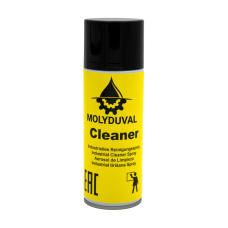
Molyduval Cleaner Spray - Degreasing and cleaning agent
Product Code: 2000078452563
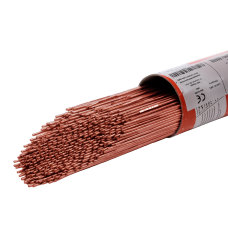
SELECTARC Al105 - Aluminium electrode with 5% Silicon for welding and repair of aluminium and aluminium alloys
Product Code: SELECTARC Al105
SELECTARC Al112 - Aluminium electrode with 12% Silicon for welding and repair of cast and extruded aluminium alloys
Product Code: SELECTARC Al112
Related Posts
What is welding?
Times Read: 481
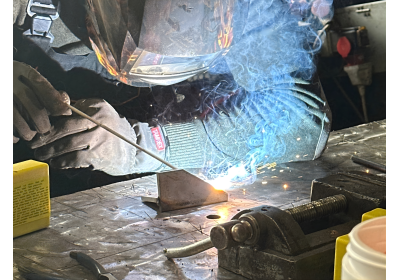
Welding is the process of joining materials in which they are heated to the melting point at the poi..
Protection of aluminum from the effects of chemistry, acid
Times Read: 1274
%20(2)-400x280.jpg "Protection of aluminum from the effects of chemistry, acid")
The binder and aluminum layer in the composition connect with the metal, with the result that a lami..
Comments